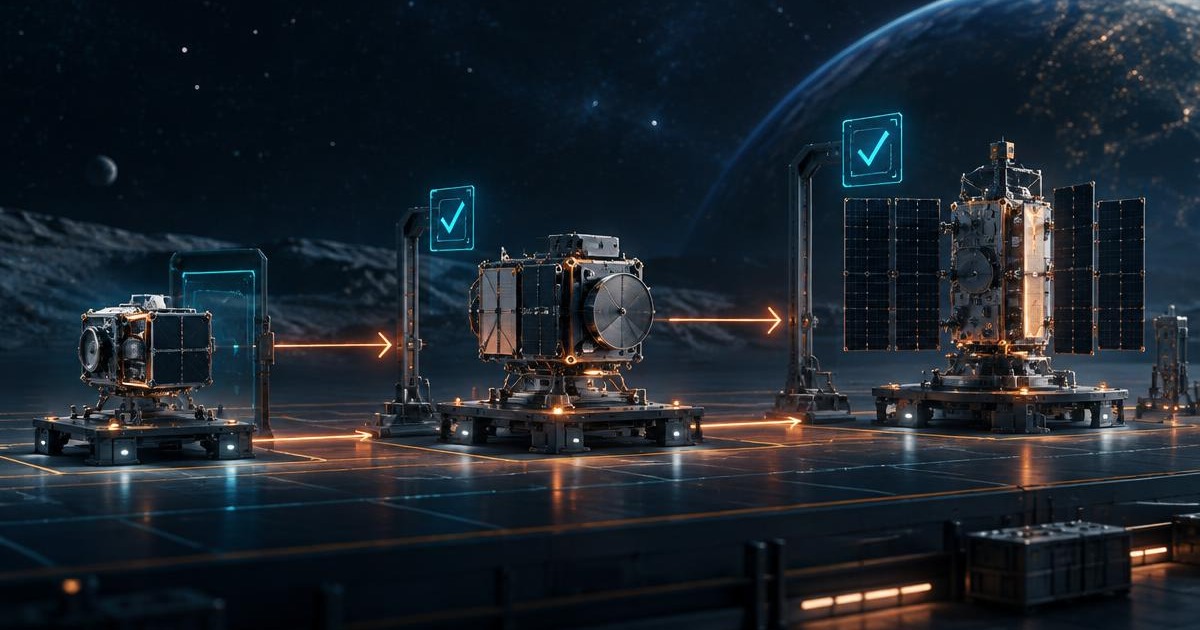
A demo can look convincing. Production begins where technology must work repeatedly, across different devices and in situations outside the ideal scenario.
That is why a solution's status needs precise language. A technically proven path is valuable, but it may not yet include monitoring, support, safe updates or an error-resolution process.
Prototype, POC, pilot and production
Prototype
Validates a concept, user experience or main flow. It may be clickable without processing real data.
Proof of concept
Validates a specific technical uncertainty: whether two systems can connect, a device accepts a command or a critical step can be completed.
Pilot
Real users or devices use the solution within a controlled scope. A pilot collects experience from an environment a lab test cannot fully reproduce.
Production
The solution is prepared for long-term operation. Beyond the main function, it needs monitoring, support, diagnostics and a controlled release process.
Terminology differs between companies; what matters more than the label is stating exactly what has been verified.
A real example: VRP Integration
We do not currently describe our VRP solution as production. VRP Integration has pilot status.
We verified the technical solution with five payment providers. The number refers to providers, not five devices or five device-acquirer combinations. Its public site is vrp.ignition.sk.
This wording does not reduce the project's value. It states which uncertainty has been removed and which operational questions are not yet closed.
What we have verified
Within the confirmed scope, we verified:
a VRP2 workflow on a PAX terminal;
the payment step in the sales workflow;
result processing;
receipt printing directly from the terminal;
a client portal;
testing with five payment providers.
These points prove a working flow between fiscal, payment and hardware components. They are not a statement of finished production operations.
Why one device is not enough
Android POS devices can differ by system version, manufacturer, SDK, communication method and built-in printer. Differences also appear in the application lifecycle: the system may suspend the app, stop it in the background or restore it after losing a connection in unexpected ways.
An integration needs to observe reconnect behaviour, the return from a payment app and interruption handling. Not every difference matters to every project; testing on target hardware reveals which ones have a real impact.
What still separates a POC from production
Depending on risk and scope, production readiness may require:
monitoring and alerts;
support-accessible logs and diagnostics;
remote device support;
a safe upgrade and rollback path;
recovery after an error or connection loss;
onboarding for users or devices;
support and escalation processes;
a security review;
performance or load testing where expected operations require it.
These are areas that separate technical validation from long-term operations. We are not claiming VRP Integration has completed all of them. Their exact scope belongs to the pilot and the decision about production deployment.
The same distinction applies when validating a new product: first state which uncertainty is being tested. See How to validate an app idea before investing in full development.
Conclusion
Trust in technology does not come from one demo. It comes from being able to state precisely what was verified, what it was tested on and what remains to be solved.